Garnette Cadogan called it his cop-proof wardrobe. He is a Jamaican essayist. He grew up in Kingston in the 1980s and assembled this outfit one day, one purpose, which was to walk down an American street and make it out the other end. The piece it appears in ran as “Walking While Black” and sits in Jesmyn Ward’s anthology The Fire This Time under the title “Black and Blue.” In this essay Cadogan compares walking “freely” in New Orleans to a 1980s Jamaica where “Wearing orange showed affiliation with one political party and green with the other, and if you were neutral or traveling far from home you chose your colors well. The wrong color in the wrong neighborhood could mean your last day.” (Garnette Cadogan, “Walking While Black,” Freeman’s, Issue One, 2015; reprinted as “Black and Blue” in The Fire This Time: A New Generation Speaks About Race, ed. Jesmyn Ward, Scribner, 2016.)
“It is a garment list with an unwritten catalogue of history attached to every single item, and I think it is the most precise piece of Jamaican fashion writing published this century.”
Editor, xaymacæ
This article is notably not filed under fashion, like much of the writing on this list. It is filed under race, under policing, under the shelf marked essays-about-walking. Nobody has ever put it in a fashion anthology as far as I can find, and that is not an oversight. It’s an unfortunate pattern.
Why the writing went sideways
Jamaica played little part in manufacturing the modern “fashion critic.” There is no Jamaican Vogue. There is no fashion desk at the Gleaner, nor anything at the Observer more than a “lifestyle” desk. Caribbean Fashion Week launched in 2001 and ran until 2019, and when it stopped it did not leave a press corps behind it. To be blunt, that is kind of embarrassing. But is it entirely true? Thankfully, the record left us photographs.
{Insert photographs}
Any serious writing about Jamaicans’ dress is done under various job titles. A poet. A sociologist who ran a dance company. An art historian working on 1920s Paris. A woman with a doctorate from Goldsmiths. A memoirist writing about her father. A man writing about walking.
This has been good for the work in one very specific way. None of these people came to clothes through clothes. They came to clothes through a question they were already chasing — one that had nothing to do with fashion. And so not one of them has ever written about a hemline without also writing about who was permitted to wear it. Go and read a season review in any of the big titles and then read Cadogan on why he can’t wear a white T-shirt. One of those is doing more work.
The cost is that there is no shelf. The record we discuss as chatter is scattered across a 1937 poetry collection, a UWI Press monograph, a V&A exhibition catalogue, a doctoral thesis in London, a memoir published in New York, and a Toronto quarterly. Six countries’ worth of institutions, no index. If you wanted to teach a course on this you would spend the first month just finding it.
And then the discovery that is harder to say politely: the best-funded thinking about Jamaican dress happens in London.....
The V&A pays for it. University of the Arts London pays for it. The Courtauld trained one of them and Goldsmiths trained another. The people writing from Kingston are doing it inside a university press with a small print run or inside a newspaper section that also has to sell tickets to its own events. Both things are true at once and I’m not going to resolve them into a moral. The London work is excellent and it exists because Britain has money and a guilty conscience about the same generation it deported. Take the money. Notice where it came from.
Here they are;
Una Marson, 1937
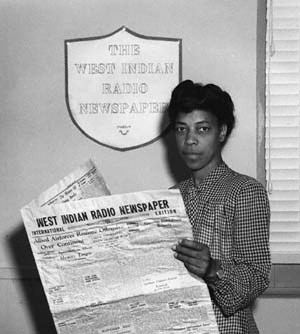
Marson’s third collection, The Moth and the Star, came out in September 1937 and contains a poem called “Kinky Hair Blues.” It is about hair. Specifically it is about wanting to straighten it, uncertainty, resentment, and doing the arithmetic on what your hair will cost you socially. She wrote it in Jamaican dialect and built it on a blues structure, so the form is doing the argument too — a Black American music holding a Black Jamaican woman’s complaint about a European standard.
1937. That is roughly seventy years before the natural hair conversation arrived as a marketing category, and Marson had already written the version with the ambivalence. She likes her Black face. She likes her kinky hair. She also knows what the men around her have been taught to prefer, and she says so instead of pretending the knowledge away.
Rex Nettleford, 1970
Rex NettlefordNo cleared portrait
Mirror Mirror: Identity, Race and Protest in Jamaica. Five essays. Sources disagree on whether it’s 1969 or 1970 — the 1970 date is the one usually printed and I’ll use it, but flag it.
To be clear, this is not a fashion book. You won’t find chapter-level material on “dress” specifically but, rather, Nettleford takes the Jamaican relationship into careful reflection — the half-identification, the buy-in to the mixture, the discomfort a person feels looking at their own inheritance — and made it a legitimate subject for serious writing. The title is the whole thesis. A mirror.
Once you have established that a Jamaican looking at themselves is also performing themselves, what you begin to see is a performance of politics, and everything downstream is available: the hair, the bleach, the Sunday suit, the uniform, the bandana. He also founded and ran the National Dance Theatre Company, so he spent four decades making decisions about what Jamaican bodies wore on a stage that was explicitly arguing about national identity. Nobody had to give him the theory. He was staging it twice a year.
Petrine Archer-Straw, 2000
Petrine Archer-StrawNo cleared portrait
Born in Birmingham to Jamaican parents, brought back to Jamaica in the early 1970s, PhD from the Courtauld, dead at fifty-six in 2012. She co-wrote Jamaican Art in 1990, the first full-length book on the subject. Before it, there wasn’t one.
Then Negrophilia: Avant-Garde Paris and Black Culture in the 1920s. The word is not hers. Négrophilie is what jazz-age Paris called its own craze, which is the detail that makes the book bite. Léger, Picasso, Man Ray, Brancusi, Sonia Delaunay: collecting African sculpture, wearing what they understood to be tribal jewellery and clothes, and courting Josephine Baker, Henry Crowder and Langston Hughes for style and vitality and otherness.
Every argument we are still having about a European house borrowing from the Caribbean was mapped, mechanism and all, by a Jamaican art historian in 2000.
She did it without a villain speech, too, which is why the book survived. The whites in it are not stupid or simply malicious. They are enchanted, and the enchantment is the instrument. That is a much more uncomfortable book than the one where somebody just steals something.
Carol Tulloch
Carol TullochNo cleared portrait
Born in Doncaster. Her father came over from Jamaica in the 1950s with everybody else. She trained as a fashion and textiles designer, at Epsom and then Ravensbourne, and she is now Professor of Dress, Diaspora and Transnationalism at UAL, based at Chelsea College of Arts, which is a job title that did not exist until somebody made the case for it.
In October 2004 she co-curated Black British Style at the V&A and edited the book that went with it, Black Style. The show covered dress from the 1950s onward: everyday clothes, traditional clothes, Sunday church dressing, street style, what came out of Black music and dance. Ordinary garments, in a national museum, treated as evidence.
Then The Birth of Cool: Style Narratives of the African Diaspora in 2016, working across Britain, Jamaica, South Africa and the United States, and pulling from ready-made and homemade clothes, photographs, paintings, films, published biographies and unpublished letters. That last category is the tell. Letters.
The phrase to take from her is style narrative. The claim underneath it is that a person assembling an outfit is composing an autobiography, and that the assembly is readable as a text. Which sounds abstract until you notice what it licenses: your grandmother’s church hat becomes a primary source. Your uncle’s Sunday suit becomes a document. Tulloch built the permission slip that most of the work on this list runs on, and she wrote herself into her own book on purpose, as a Black woman raised in Britain trying to place herself, rather than standing outside it pretending to be a camera.
Christine Checinska
Christine ChecinskaNo cleared portrait
She has the keys.
British Jamaican, womenswear designer first, then art historian, now the V&A’s inaugural Senior Curator of African and African Diaspora Fashion and Textiles — a post that did not exist before her. She was lead curator of Africa Fashion, July 2022 to April 2023. She sat on the advisory committee for Superfine: Tailoring Black Style at the Met in 2025, the show that put Ivy Ralph’s Kariba on a wall in New York. In 2025 she took a research fellowship at the Yale Center for British Art.
Her 2016 TEDx talk is called “Disobedient Dress: Fashion as Everyday Activism,” and the line from it that we already quoted in the Windrush piece is that Caribbean migrants dressed well “as a way of showing respect for ourselves and to others.” Not as vanity. As a discipline, handed down.
But the detail I keep coming back to is the title of her doctorate. Goldsmiths, 2009: Colonizin’ in Reverse! — on how creolised Caribbean culture reshaped English male dress, and on why so few culturally diverse voices are in fashion and textile studies in the first place. She named her PhD after a Louise Bennett poem. The most senior Caribbean fashion curator in the world took her thesis title from Miss Lou, which means the woman we credit with the bandana is also, quietly, in the footnotes at the V&A. That is a lineage doing its job.
Donna P. Hope
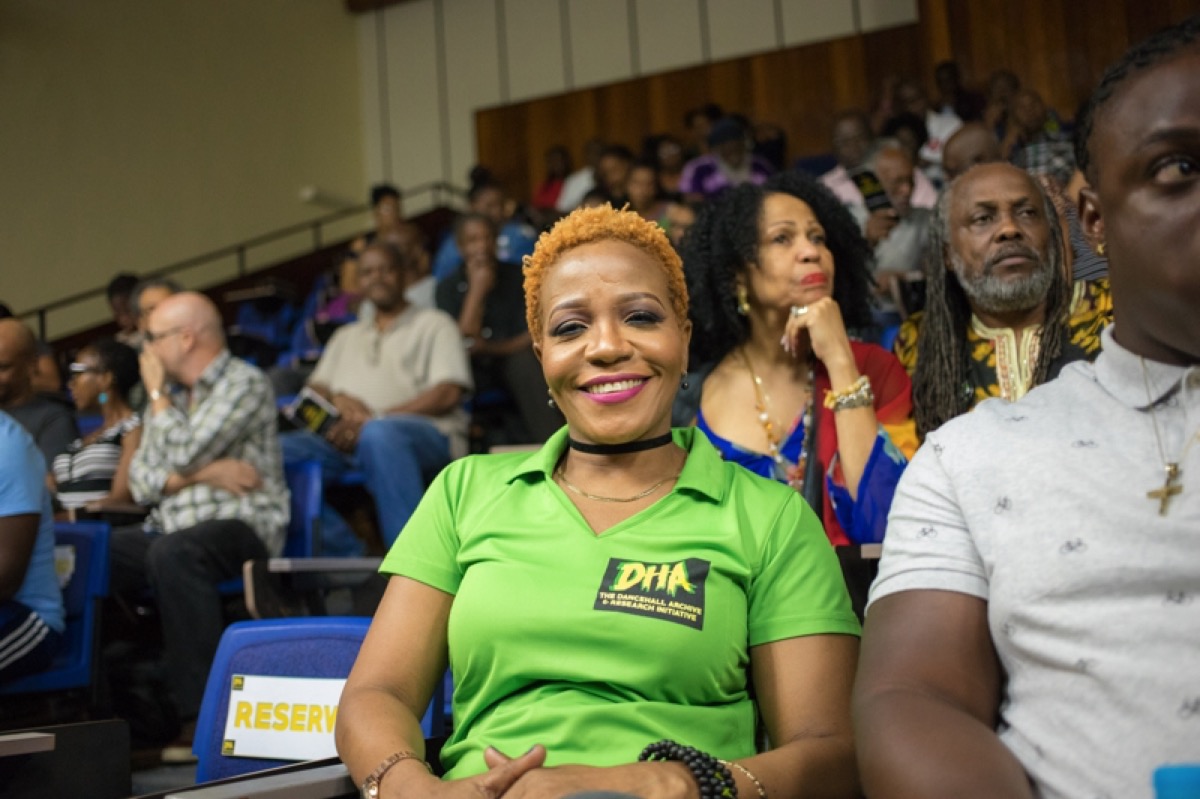
Everyone above this line works from a British or American institution. Hope works from Mona.
She is a professor at the Institute of Caribbean Studies and the Reggae Studies Unit at UWI Mona — the first professor named at that Institute in its thirty-plus years, which is its own quiet indictment of how the subject was rated. Inna di Dancehall came out of UWI Press in 2006, Man Vibes: Masculinities in the Jamaican Dancehall from Ian Randle in 2010. In February 2018 she set up the Dancehall Archive and Research Initiative, because somebody had to actually keep the material.
The paper to read is “Fashion Ova Style,” which takes the dancehall’s own phrase and uses it to think about skin bleaching. That is the move. Hope reads the body itself as part of the outfit — the bleached skin as an extension of the fit, on a continuum with the clothes rather than in a separate moral category marked tragedy.
I don’t find that comfortable and I don’t think it’s supposed to be.
Dancehall is the most consequential thing to happen to Jamaican dress in forty years and respectable Jamaica spent most of that time treating it as noise. Hope is a large part of the reason it is now a field with citations instead of a moral panic with a newspaper column.
Garnette Cadogan
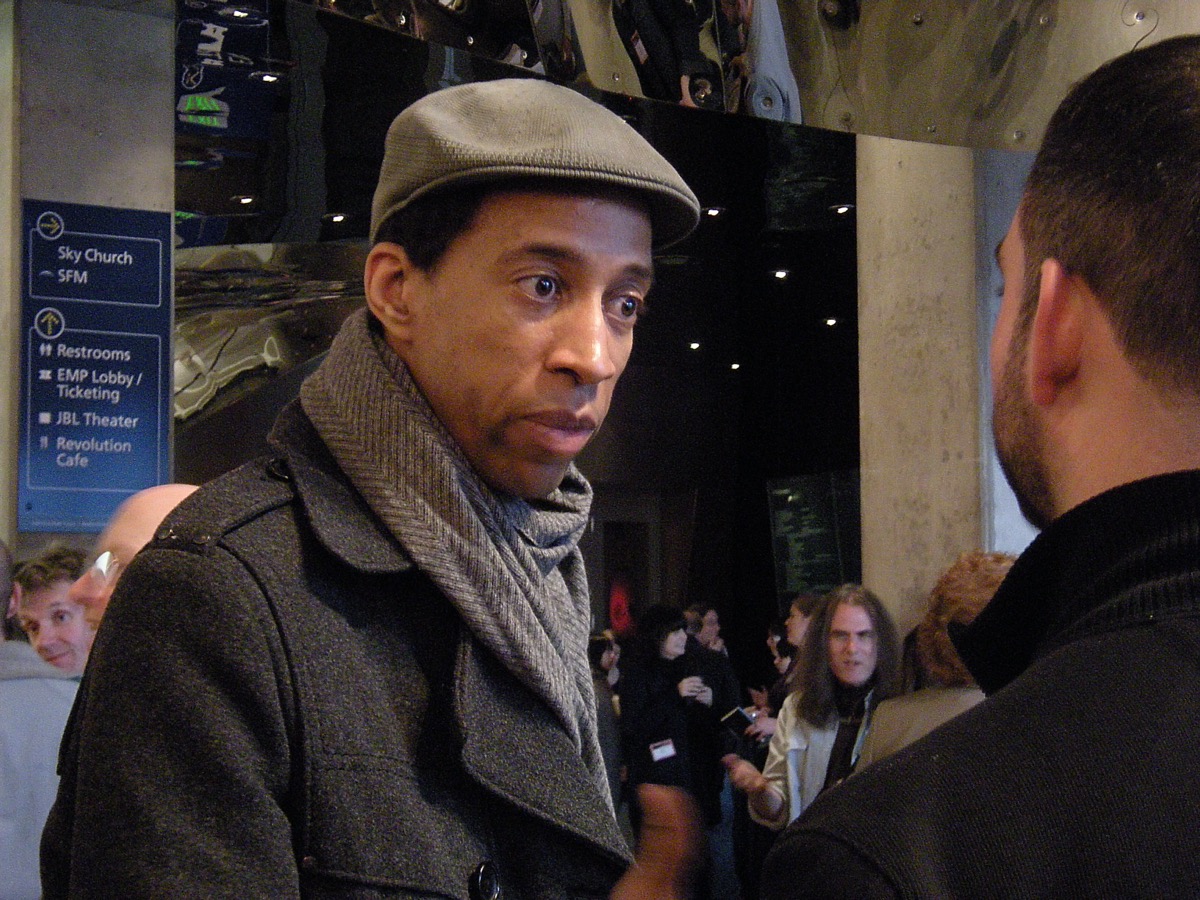
Back to the wardrobe.
What makes the essay work is that Cadogan has two countries to compare and he refuses to make either one the good one. In Kingston in the 1980s, the danger in clothing was colour and territory: wear the wrong shade into the wrong community during the tribal years and you could be killed for it. He learned to read a street through what it was safe to wear on it before he ever left the island.
Then America, where the calculation is different but he is running the same software. The white T-shirt and blue jeans — the most ordinary American male outfit there is — goes off-limits, because in the eyes reading him it is the uniform of a Black troublemaker. So he assembles the oxford shirt and the V-neck and the university crest instead. Ivy League, worn defensively.
And he keeps the Clarks. Read the Clarks piece for what that shoe carries in Jamaica. In an outfit engineered top to bottom to make him legible as harmless to an American police officer, the one thing he will not surrender is the desert boot. That is not an accessory decision. That is a man conceding almost the entire argument and holding one item back.
Safiya Sinclair
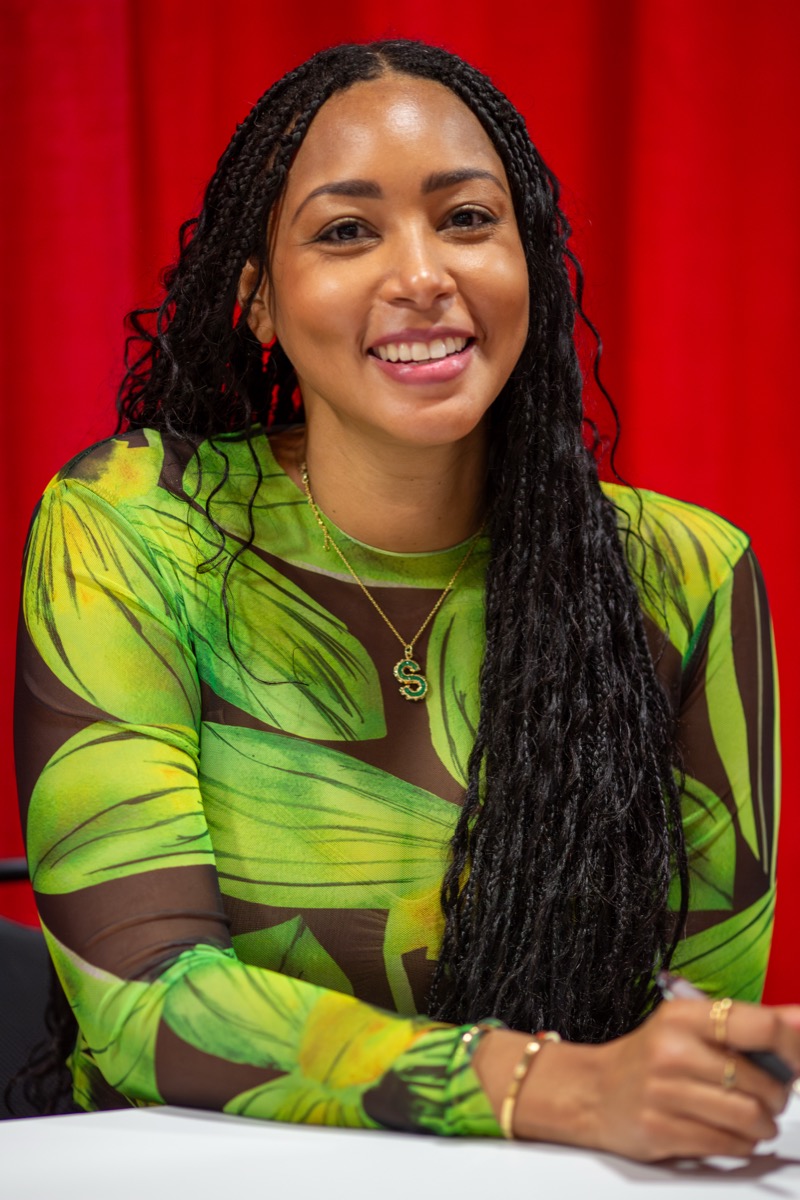
How to Say Babylon, 2023. Montego Bay, a devout Rastafari household, a father whose beliefs set what she ate, who she could befriend, and what she was allowed to put on her body. Long skirts and dresses. Arms covered, legs covered. Head wrapped. No makeup, no jewellery.
At nineteen she cut her locs and became, in her own word, a ghost to him.
Her line on why is exact: in Jamaica, wearing your dreadlocks tells anyone near you that you are Rastafari. It is a signifier, and she uses that word. So cutting them is not a haircut. It is a public renunciation, performed on the head, visible to everybody on the road before you have said anything.
Nearly all the writing on this list, including most of ours, reads Jamaican dress as resistance. Sinclair wrote the other book. Inside the movement that the rest of the world files under liberation — the one that sells the most Jamaican clothing worldwide by an enormous margin — there was a household where dress was the instrument of control, and the person controlled was a girl. Both readings are accurate. Neither cancels the other. Hold them at the same time or don’t bother.
Novia McDonald-Whyte
Novia McDonald-WhyteNo cleared portrait
She is the only person here who had to file about clothes on deadline, in Jamaica, for nearly thirty years.
She joined the Jamaica Observer in 1997 and is Senior Associate Editor for Lifestyle. She built the events the local industry organises its calendar around — Style Week, the thing that started as Fashion’s Night Out and became Jamaica Observer Takes Style Out, Design Week JA, the Table Talk Food Awards. She has an Order of Distinction and a pair of white-framed glasses that function as a signature.
The academics on this list get citations and a permanent collection. McDonald-Whyte got a masthead and a beat, and she kept the beat alive through the entire period when Caribbean Fashionweek rose, peaked and folded. That matters more than the citation count for the simple reason that she was there every week.
The complication is structural and it is not her fault. In a market this size, the only way sustained fashion coverage has ever been paid for in Jamaica is by the coverage also running the events. Editorial and production sit in the same office. That is how the beat survived and it is also the ceiling on what the beat can say, and until somebody funds a Jamaican fashion desk that doesn’t have to sell tickets, that ceiling stays exactly where it is.
Sharine Taylor
Sharine TaylorNo cleared portrait
The newest of them, and the closest to what we are trying to do here, so I’ll declare that up front.
Afro-Jamaican, based in Toronto, writer and critic and editor. Bylines at Dazed, Nylon, The FADER, Pitchfork, VICE, Shondaland, BuzzFeed. In 2017 she founded BASHY Magazine, quarterly, print and digital, made by and for Jamaica and its diaspora, publishing essays, op-eds, criticism, interviews, profiles and poetry from Jamaican writers, photographers and artists.
She has said the magazine came out of frustration and that the point is to put how Jamaica gets understood back into the hands of Jamaican creatives. That is the correct reason to start a publication and the only one that survives the second year.
The plumbing: Stuart Hall and Annie Paul

Two people who belong here without quite fitting the brief.
Stuart Hall was born in Kingston in 1932, died in London in 2014, and as far as I know never wrote a word about a garment. It doesn’t matter. “Cultural Identity and Diaspora” and the work around it gave the field the idea that identity is something produced and positioned rather than something dug up, and both Tulloch and Checinska are working with tools he made. When Wales Bonner says she is representing that there is no one resolved idea of Blackness, that sentence has Hall’s fingerprints on it whether or not anybody says so out loud.
Annie Paul is a writer and critic based at UWI Mona, where she heads publications at SALISES. Born in Kerala in 1956, Jamaica-based for decades, a founding editor of Small Axe, author of the blog Active Voice, now editor-in-chief of PREE. She writes on Caribbean art and popular culture in places like Wasafiri, Callaloo, BOMB and the Guardian, and in 2020 she published a life of Stuart Hall for UWI Press. So the Kingston-based critic wrote the biography of the Kingston-born theorist that the London-based professors are citing. Small country.
Annie PaulNo cleared portrait
What’s actually missing
Nobody on this list set out to be a fashion writer. Marson was a poet. Nettleford was a sociologist with a dance company. Archer-Straw was an art historian. Cadogan is an essayist. Sinclair is a poet writing a memoir about her father. The two who did choose it — Tulloch and Checinska — had to go to Britain to get a post that would pay for it, and one of them had to invent the post.
So when somebody asks who Jamaica’s fashion writers are, the honest answer is: these people, and most of them weren’t. They wrote it into whatever container they already had. A blues poem. A monograph. A thesis title. An exhibition wall. A memoir about a father. An essay about walking to the shop.
That is not a canon. That is a scatter.
Una Marson published in 1937. Eighty-nine years on there is no chair, no desk, no beat, no shelf. Just very good writing about how we dress, sitting in eleven different rooms with somebody else’s name on the door.