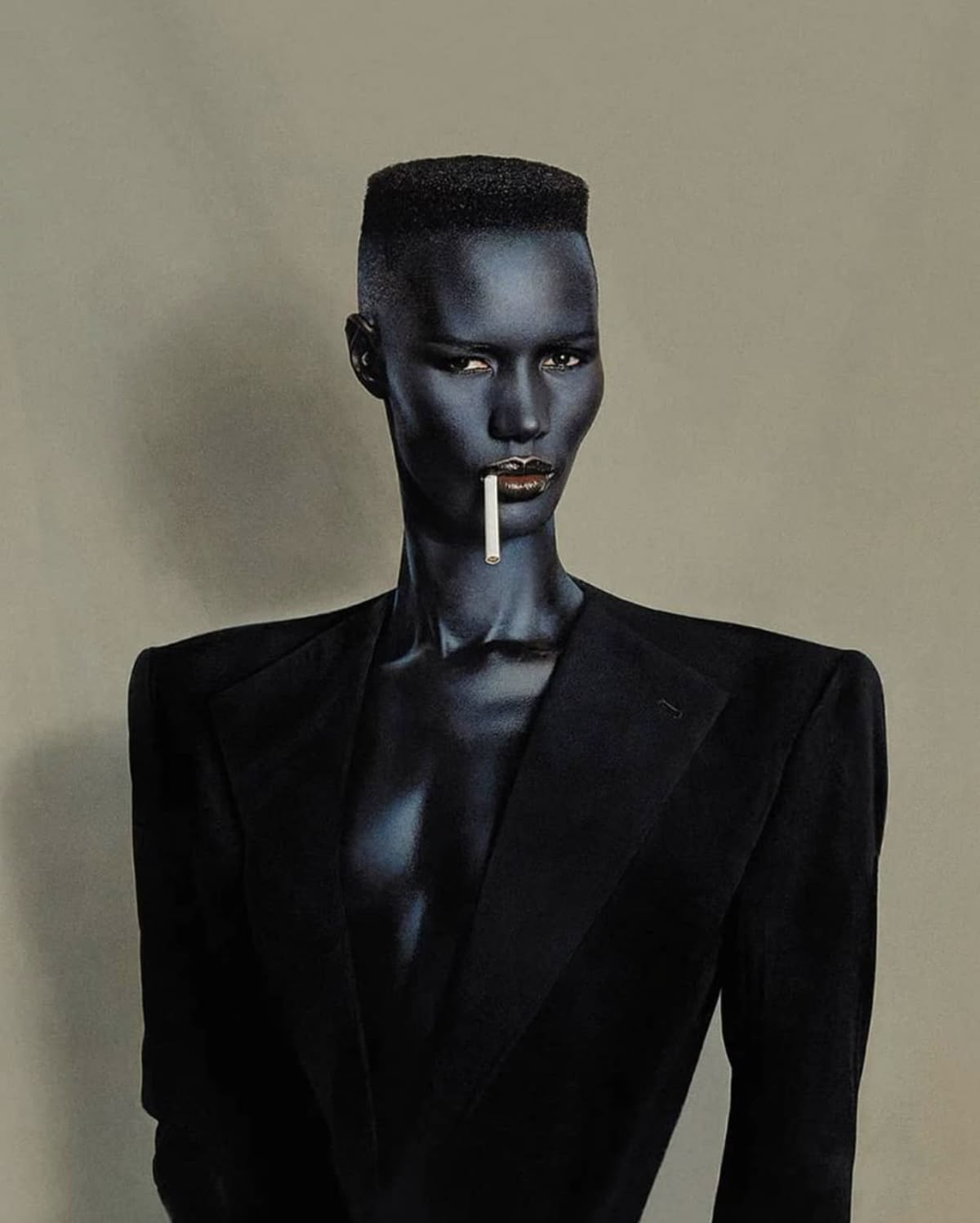
Jones had been modeling since the early 1970s, working the Paris circuit alongside Jerry Hall and Jessica Lange, mostly invisible despite her height and her face. The industry was still deciding what to do with Black models in that era: place them carefully, use them sparingly, always kept warmly in the paradigms of what was already understood. Black bodies often appeased the times, while Black motifs were happily sidelined.
Jones decided, apparently around 1977, that she wasn’t interested in being understood.
Jones’s splash into the world of New York fashion was beyond attention grabbing. Jones was able to affect the five senses of New York. Her visuals striking. She introduced New York to musicians from Jamaica, dancehall’s toasting changing the canon of American popular music forever. The Muse album in 1979, the Goude shoots, the geometric flat-top that became her signature — it was less a career than a sustained act of visual argument. Her body was photographed in impossible angles, spliced, fractured, reassembled. She appeared metallic, architectural, barely human. The point wasn’t beauty in any conventional sense. She didn’t invite you to look at her the way you’d look at Christie Brinkley. She made you aware you were being watched back.
This matters in the context of Jamaica, which is where Jones was born in 1948 in Spanish Town, and which she left at twelve for Syracuse, New York, and later for Paris. Jamaica’s global export at that moment was a specific warmth: Rastafarian imagery, reggae, beaches, a certain knowing ease. Bob Marley. The tourism board. The idea of an island that welcomed you.
Jones exported the opposite. Cold. Futuristic. Unsettling. Her Jamaican-ness wasn’t in the texture of her imagery but in what the imagery refused — the postcolonial assumption that a small Caribbean island produces culture for other people’s consumption. She wasn’t exporting a feeling about Jamaica. She was exporting a vision that happened to come from someone Jamaican, and there’s a difference.
The art critic Edward Lucie-Smith, who wrote the definitive book on Albert Huie, described the Jamaica of the late colonial era as a place where identity was being actively invented rather than inherited. Jones, who left before she was old enough to be shaped by the nationalist project Huie lived through, arrived at something similar by a completely different route. She invented an identity so aggressively constructed it couldn’t be assigned to any pre-existing category.
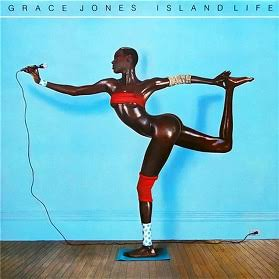
The Goude photographs hold up better than almost anything else from that period. Look at the Island Life cover from 1982: Jones in a flat-top, contorted into a near-impossible backbend, wearing nothing but a G-string and a coat of body oil. It should feel dated. Instead it looks like it was shot last year for a brand that charges $800 for a T-shirt. The post-apocalyptic styling, the androgyny, the sense that the body is a material to be worked with rather than a vehicle for relatability — these are everywhere now. Jones was doing it forty years ago in a photographer’s studio in New York.
She also recorded six albums between 1977 and 1985, several of them genuinely good, one of them — Nightclubbing — still cited by producers and DJs as a reference point for the exact temperature a certain kind of music should be. The fashion world tends to strip the music away, which is a mistake. The voice was part of the persona, not an addition to it. Deep, unhurried, faintly threatening. It matched the photographs.
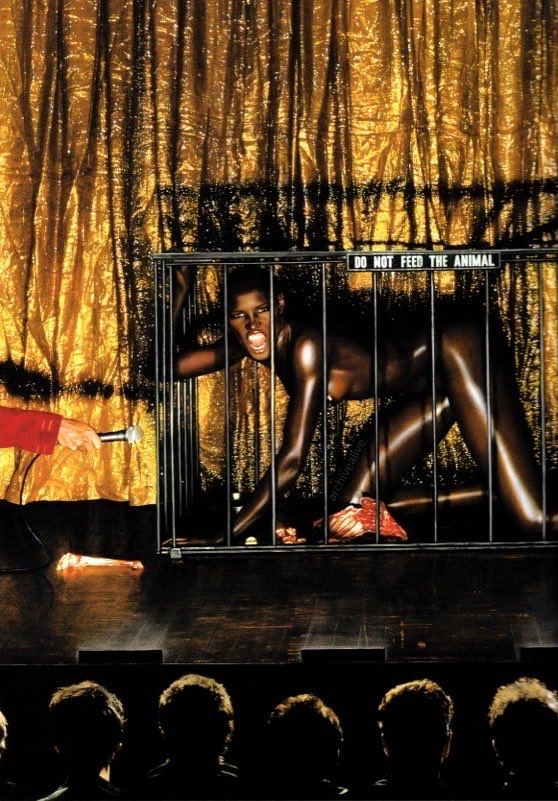
None of this is to say Jones was always in control of how she was read. Goude’s images, however collaborative, often landed differently outside the context of their creation. The cage photograph in particular generated debate about whether Jones was challenging dehumanizing representations of Black women or providing fresh material for them. Jones herself has been inconsistent on the question in interviews, sometimes claiming full authorship of the imagery, sometimes acknowledging the complications.
That tension is what makes her interesting, actually. The original essay about Jones treats her as a settled icon, a solved problem. She isn’t. She’s a figure whose images are still doing work, still making people argue about what they mean. That’s rarer than the fashion industry’s hunger for icons typically allows.
She’ll turn 78 this year. She performed at festivals well into her sixties, arriving hours late, unbothered, still in the flat-top. Whether that’s discipline or delusion probably depends on what you think she was doing in the first place.
Jamaica has produced musicians who changed how the world sounds. Jones did something stranger: she changed how a version of the world looked, and she did it without warmth, without invitation, without making it easy. That’s not a legacy. It’s just what happened.